Affordable solar power solutions in Abuja
Best Solar & Inverter Setups in Abuja by Budget (₦300k – ₦10M) — 2026 Guide
A practical, no-fluff breakdown of what you can actually get for your money
Table of Contents
Introduction: Why This Guide Exists
Let me be upfront with you. When most people start researching solar in Abuja, they hit two walls almost immediately. The first wall is the vague pricing — you call a company, they ask for your address, you never hear back. The second wall is the jargon — 12V, 48V, MPPT, hybrid, tubular, lithium — and nobody explains what any of it actually means for your daily life.
This guide cuts through both.
Whether you have ₦300,000 to start or ₦10 million to go fully off-grid, this breakdown tells you exactly what you can realistically get for your money in Abuja right now, what components you’ll need, what to prioritise, and what to leave out until your budget grows.
I’ll also share my own personal journey — starting from a single 1KVA inverter and one battery, all the way to where I am today and where I’m headed next. Because sometimes the most useful thing isn’t a technical spec sheet — it’s hearing from someone who has actually been through the upgrades, made the mistakes, and learned what works.
Before diving in: For a list of vetted solar installation companies in Abuja who can help you execute any of these setups, see our guide on the Top Solar Installers in Abuja (2026).
Important Disclaimer on Prices
Solar component prices in Nigeria are genuinely volatile. The exchange rate, import duties, demand spikes, and supplier availability can shift prices week to week — sometimes significantly. Everything in this guide is a directional estimate based on current market conditions in Abuja as of 2026.
Always verify current prices on:
- Jiji.ng – Abuja Solar Energy Products
- Jiji.ng – Solar Panels
- Jiji.ng – Complete Solar Power Systems
- Jiji.ng – Portable Solar Products
Get at least two or three quotes before buying anything. Prices you see online are often negotiable, especially for bundle purchases.
Understanding the Basics Before You Buy
Before we get into the budget tiers, let’s clarify the concepts that will save you from expensive mistakes.
12V vs 24V vs 48V Systems — What’s the Difference?
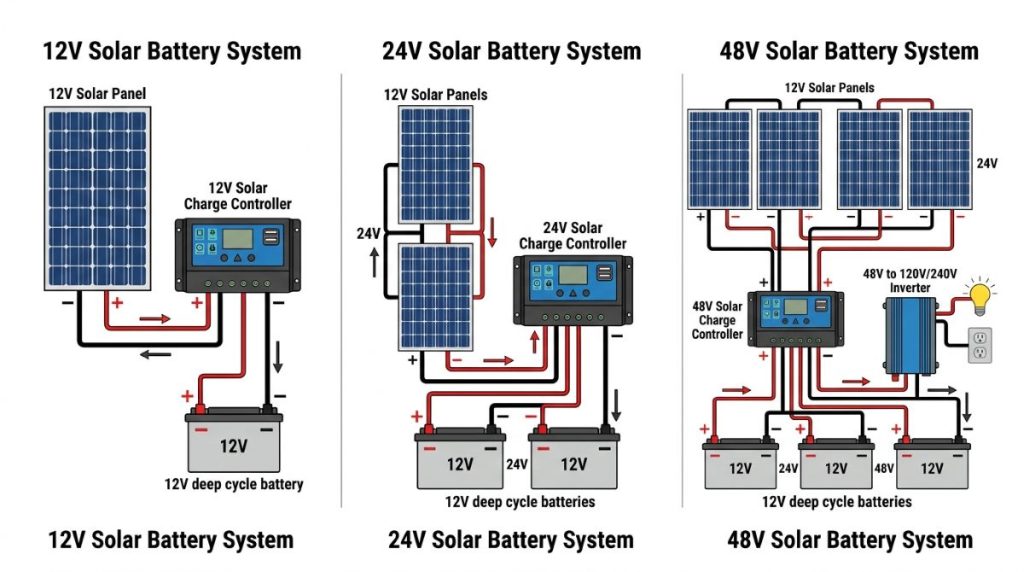
This is one of the most overlooked decisions in a beginner solar setup, and getting it wrong costs you real money.
12V System The simplest entry point. Best for small loads — lights, fans, a TV, phone charging. One or two batteries. Easy to set up and cheap to start. The limitation is efficiency: at 12V, you lose more energy as heat through your cables, and the system struggles to scale beyond two batteries without voltage drop issues.
24V System The sweet spot for most Abuja homes. More efficient than 12V, handles larger loads, pairs better with medium-capacity inverters (1.5KVA–5KVA), and scales better with multiple batteries. Most modern hybrid inverters operate at 24V. If you’re thinking beyond the basics, start here.
48V System For serious setups — large homes, businesses, or off-grid systems. More efficient over long cable runs, handles high loads, and pairs with high-capacity inverters (5KVA and above). Requires more batteries to reach 48V (typically four 12V batteries in series or two 24V batteries). Higher upfront cost, but the right call for anyone doing a full-house system.
Rule of thumb: If your budget is under ₦1.5 million, start with 24V. If you’re going above ₦3 million and planning a comprehensive system, go 48V.
Battery Types: Tubular vs Lithium
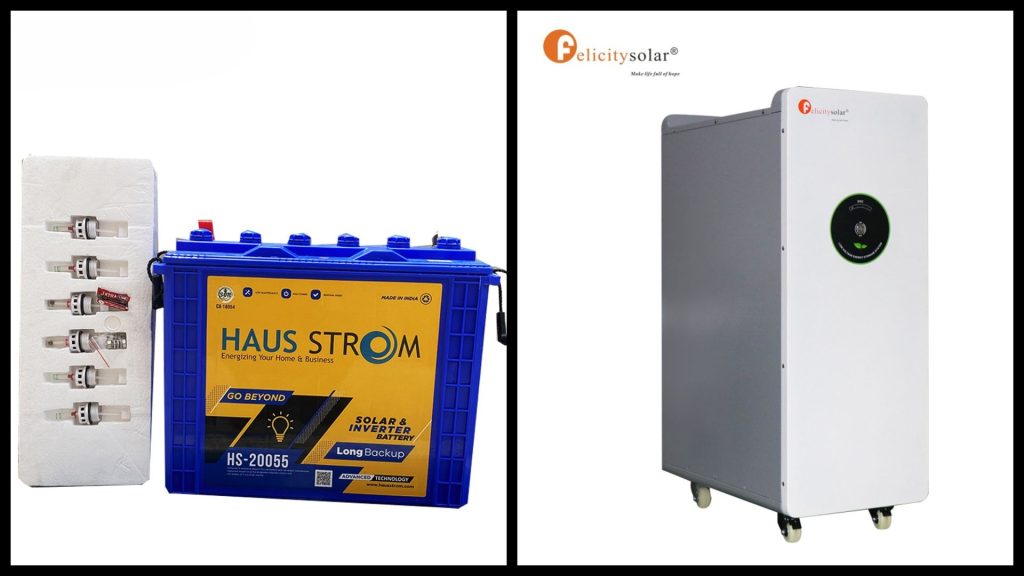
Tubular Batteries (Flooded Lead-Acid) These are the workhorse of budget solar setups in Nigeria. A 200–220Ah tubular battery typically starts from around ₦150,000–₦250,000 depending on brand and market conditions. They work, they’re repairable, and they’re widely available. The downsides: they require quarterly maintenance (topping up with distilled water), they’re heavy, they emit gas during charging (need ventilation), and their usable capacity is only about 50% of their rated capacity before you risk damaging them.
Lithium Batteries (LiFePO4) More expensive — quality lithium batteries for solar start from around ₦800,000–₦1,000,000 per unit and upward. But they’re a different product entirely. You can use 80–90% of their rated capacity, they last 8–15 years versus 3–5 for tubular, they require zero maintenance, and they’re significantly lighter. For anyone with budget above ₦3 million, lithium is the long-term smarter investment.
Short version: Under ₦1 million budget — tubular. Above ₦3 million — strongly consider lithium.
Solar Panels: Mono, Poly, Bifacial — Which Should You Buy?
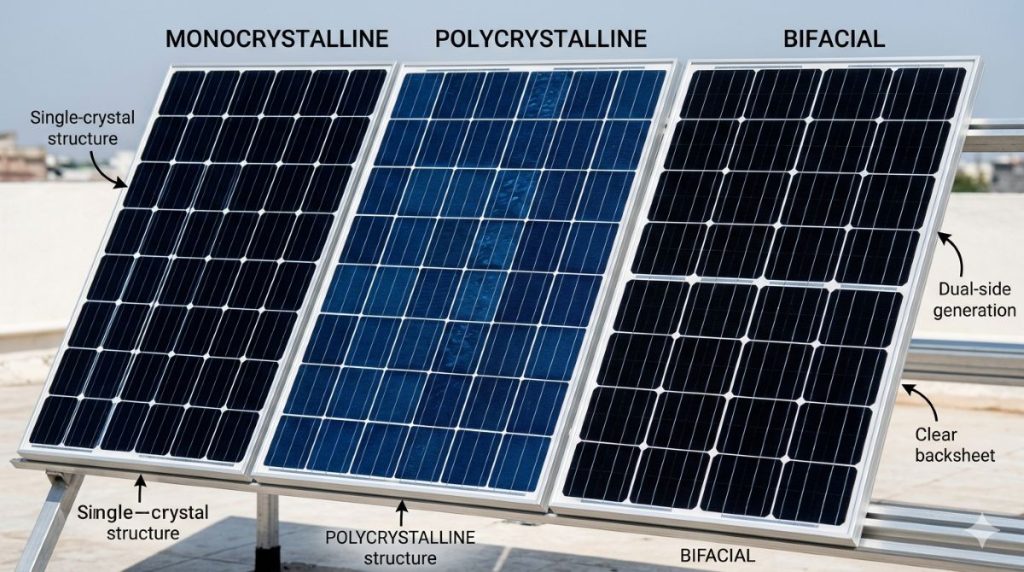
Monocrystalline Panels The most common and recommended for residential use in Abuja. Higher efficiency (18–22%), better performance in low-light conditions, longer lifespan. These are what most reputable installers will recommend. Available in a range of wattages — 180W, 280W, 350W, 450W, 550W, 600W.
Polycrystalline Panels Slightly cheaper, slightly less efficient. Still functional but increasingly being phased out in favour of mono panels whose prices have dropped significantly.
Bifacial Panels These panels generate power from both sides — the front absorbs direct sunlight, the back captures reflected light from the ground or surface beneath. More efficient overall, especially on reflective rooftops. Higher cost, but worth considering for a premium setup. Good for tilt-mounted rooftop or ground installations.
Recommendation: Go monocrystalline as a minimum. If budget allows for bifacial, the extra efficiency gains over 15–20 years are meaningful.
Inverters: Traditional vs Hybrid
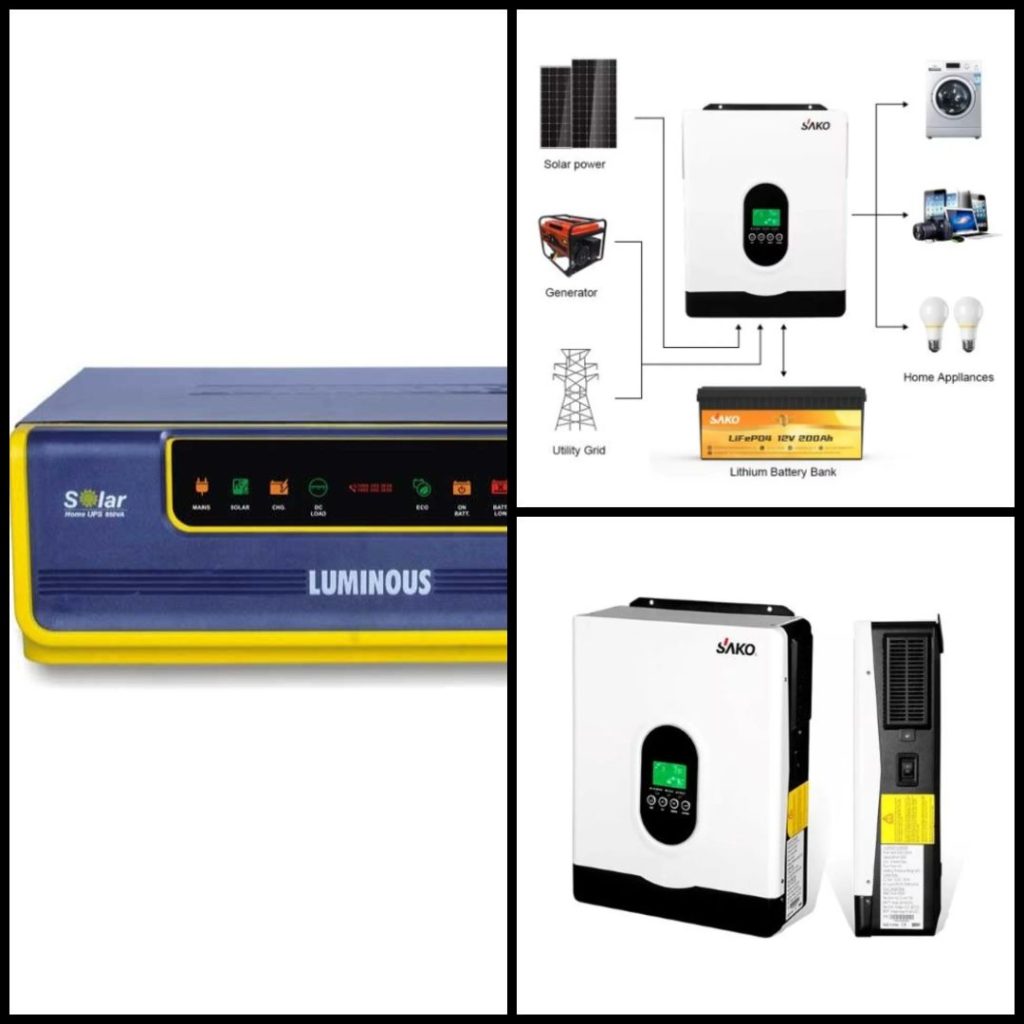
Traditional (Pure Sinewave) Inverter Converts DC battery power to AC power for your home. That’s it. No solar charging, no grid interaction. You charge the battery from AEDC, then the inverter powers your home when AEDC goes down. Simple and cheap, but limited.
Hybrid Inverter The smarter option. A hybrid inverter manages three power sources simultaneously — solar panels, battery storage, and the national grid. It can:
- Push your load entirely to the grid when AEDC is available (saving battery)
- Switch to solar panels during peak sun hours to reduce grid dependence
- Draw from batteries when neither grid nor sufficient solar is available
- Prioritise charging batteries from solar during the day for use at night
In practice, this means your batteries last longer, your solar panels are used more efficiently, and your AEDC consumption drops significantly. Most inverters sold today in Abuja’s serious solar market are hybrid. Examples include the De-Bull hybrid range, Growatt, Victron, Deye, and others.
Price ranges from 150k upto 500k for traditional inverters, Hybrid inverters range from 250k to 1M and even more.
Charge Controllers: MPPT vs PWM
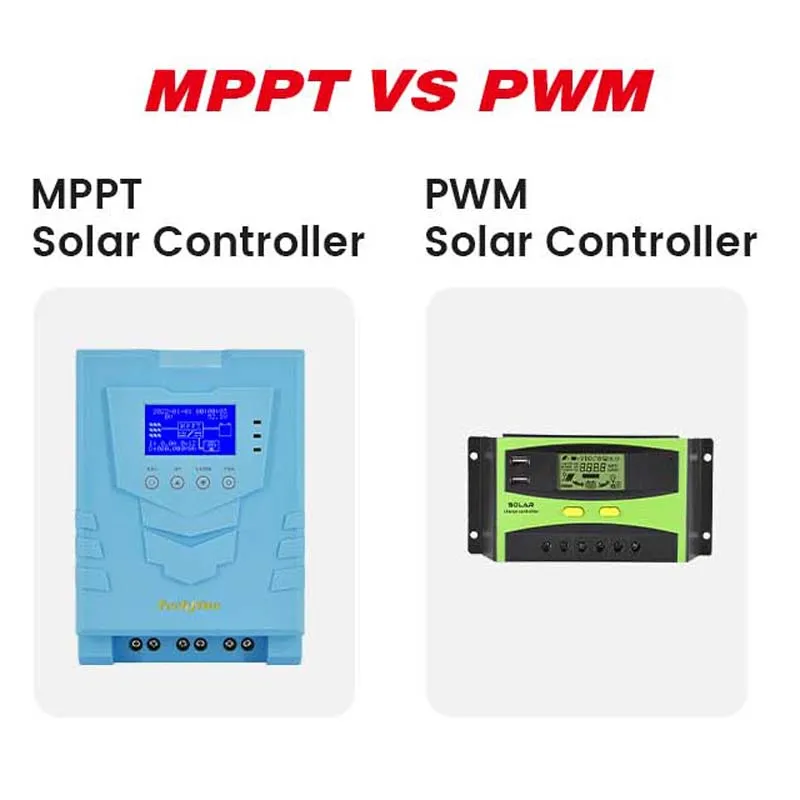
If your system isn’t purely a hybrid inverter (some hybrids have built-in MPPT), you’ll need a charge controller between your solar panels and batteries.
PWM (Pulse Width Modulation): Older, cheaper, less efficient. Fine for very small systems but wastes a portion of your panel’s potential output.
MPPT (Maximum Power Point Tracking): More expensive but extracts significantly more power from your panels — up to 30% more in real-world conditions. For any system above the most basic level, MPPT is worth the extra cost. Price by load and system size — do your research and get quotes.
DC & AC Breakers — Don’t Skip This
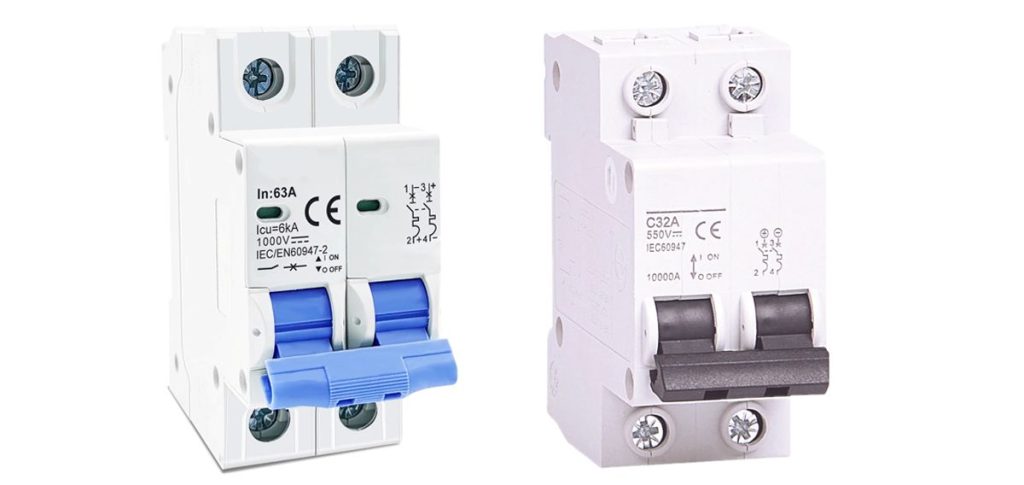
This section deserves a special mention because it’s the component most beginners either skip or underinvest in, and it’s the one most likely to save your house from a fire.
DC breakers protect the wiring between your solar panels and your inverter/charge controller. AC breakers protect your home circuits from overcurrent on the output side.
Breaker prices in Abuja run from roughly ₦10,000 to ₦20,000 or more depending on amperage rating and brand. This is not where you cut corners. A proper breaker setup also includes surge protection and proper earthing — especially critical in Abuja where lightning strikes during rainy season are not uncommon.
Any installer who quotes you a system without specifying breakers and earthing in the breakdown — ask them directly why.
Professional Installation Fees
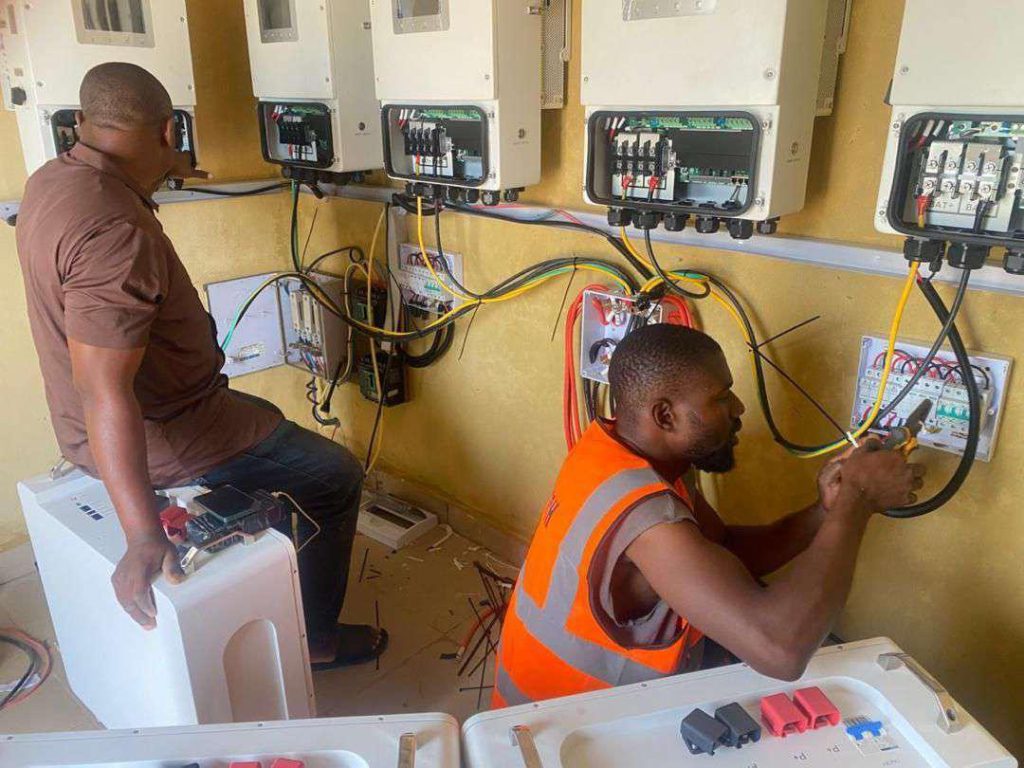
Installation fees in Abuja vary based on system complexity, roof type, number of panels, and the installer’s experience level. As a rough guide, basic installations start from around ₦50,000 and can go significantly higher for larger or more complex setups. For a mid-range hybrid system, budget between ₦80,000 and ₦200,000 for professional installation.
This is not an area to save money on by hiring whoever is cheapest. Poor wiring, incorrectly sized cables, bad earthing, and improper breaker sizing cause fires and system failures. Hire certified professionals. See our Top Solar Installers in Abuja guide for vetted options.
Load Calculation: Know What You’re Actually Powering
Before any installer gives you a proper quote, they should ask for your load list. This is simply: what appliances do you want to run, and for how many hours per day?
Example basic load calculation:
| Appliance | Watts | Hours/Day | Daily Wh |
|---|---|---|---|
| 4 LED bulbs | 40W | 8hrs | 320Wh |
| 2 ceiling fans | 120W | 10hrs | 1200Wh |
| 32″ LED TV | 60W | 6hrs | 360Wh |
| Phone charging | 30W | 4hrs | 120Wh |
| Total | 2,000Wh/day |
A 2,000Wh daily need tells you approximately how much battery capacity and solar panel wattage you need. Your installer should use this to size your system properly. If they don’t ask — that’s a red flag.
Essential vs Non-Essential: On a budget system, be disciplined. Run lights, fans, TV, phone charging, and a small fridge on the inverter. Leave ACs, electric water heaters, electric cookers, irons, and washing machines on the main grid or generator until your system can handle them. Adding these to an undersized system will drain your batteries faster than you can charge them.
5 Affordable Solar power solutions in Abuja
(Budget Tier Breakdown)
Tier 1: ₦200,000 – ₦600,000 — The Starter Setup
What this gets you: Basic lighting, fans, TV, phone charging. No solar panels in the cheapest configurations — just inverter and battery.
Typical components:
- 1KVA–1.5KVA pure sinewave or entry-level hybrid inverter
- 1–2 tubular batteries (200–220Ah, 12V system)
- Optional: 1–2 solar panels (180W–280W)
- Basic charge controller (if panels added)
- DC and AC breakers
What to expect: Without solar panels, this setup is fully dependent on AEDC to charge the battery. When power goes, you have stored battery power — typically 8–15 hours of light usage from one 220Ah battery before it needs recharging. Add two panels at this level and you start getting daytime charging that extends your independence.
Best for: Renters, students, or anyone testing the waters before committing to a bigger investment.
Jiji research link: Abuja Solar Energy Products
Tier 2: ₦700,000 – ₦1,000,000 — Basic Home Use
What this gets you: Reliable power for lights, fans, TV, fridge, and basic appliances with a reasonable run time even without AEDC.
Typical components:
- 1.5KVA–2KVA hybrid inverter (24V system)
- 2 tubular batteries (220Ah each)
- 2–3 solar panels (280W–350W each)
- MPPT charge controller (if not built into inverter)
- DC and AC breakers with surge protection
What to expect: With two batteries and a couple of decent panels, you’re now in a position to run moderate loads through the night and recharge meaningfully during the day. A fridge can now be included — but read the section below on smart appliance usage to protect your batteries.
Best for: 1–2 bedroom apartments, small offices, or anyone ready to genuinely reduce AEDC dependence.
Tier 3: ₦1,000,000 – ₦3,000,000 — Mid-Level Home System
What this gets you: Solid whole-apartment or small-house coverage. Multiple rooms, fridge, DSTV, laptops, fans, lighting — running comfortably.
Typical components:
- 2.5KVA–3.5KVA hybrid inverter (24V or 48V)
- 2–4 tubular batteries or 1 lithium battery
- 3–6 solar panels (350W–600W each)
- Built-in or separate MPPT charge controller
- Full breaker and earthing setup
- Professional installation
What to expect: This is the range where solar starts feeling like a real solution rather than a workaround. A 2.5KVA hybrid inverter with four panels and two good batteries can power a full apartment through 24 hours with moderate usage. The hybrid function means your system intelligently draws from grid, solar, or battery depending on availability — extending battery life and maximising solar use.
Best for: 2–3 bedroom apartments, small businesses, remote workers with heavy device usage.
Tier 4: ₦3,000,000 – ₦6,000,000 — Full House Coverage
What this gets you: Whole-house power including small air conditioning units, multiple large appliances, and genuine energy independence for most of the day.
Typical components:
- 5KVA hybrid inverter (48V system)
- 4–6 tubular batteries or 2 lithium batteries
- 6–10 solar panels (450W–600W each, consider bifacial)
- Professional-grade MPPT controller
- Full distribution board with breakers
- Earthing and lightning surge protection
- Professional installation
What to expect: At this level, you’re building a real power infrastructure. A 5KVA system on 48V with quality panels and good battery storage can comfortably power a 3-bedroom home — including a 1HP split AC if used judiciously. Hybrid management means the system handles load distribution intelligently.
Best for: 3–4 bedroom homes, small commercial spaces, anyone serious about energy independence.
Tier 5: ₦6,000,000 – ₦10,000,000+ — Full Off-Grid or Commercial Systems
What this gets you: Complete energy independence. Multiple ACs, large loads, commercial operations, 24/7 reliability.
Typical components:
- 7.5KVA–10KVA+ hybrid or off-grid inverter (48V)
- 8–12 lithium batteries or 8–12 tubular batteries
- 12–20+ solar panels (600W bifacial monocrystalline)
- Industrial-grade MPPT controller
- Full commercial-grade electrical distribution setup
- Remote monitoring system
- Professional installation and commissioning
What to expect: This is the no-compromise setup. Multiple ACs, water pumps, large fridges and freezers, commercial equipment — all running on solar with full battery backup. Well-designed systems at this level can run a medium-sized business or a large family home without touching AEDC for days at a time.
Best for: Large homes, SMEs, offices, event centres, medical facilities, and anyone committed to long-term energy independence.
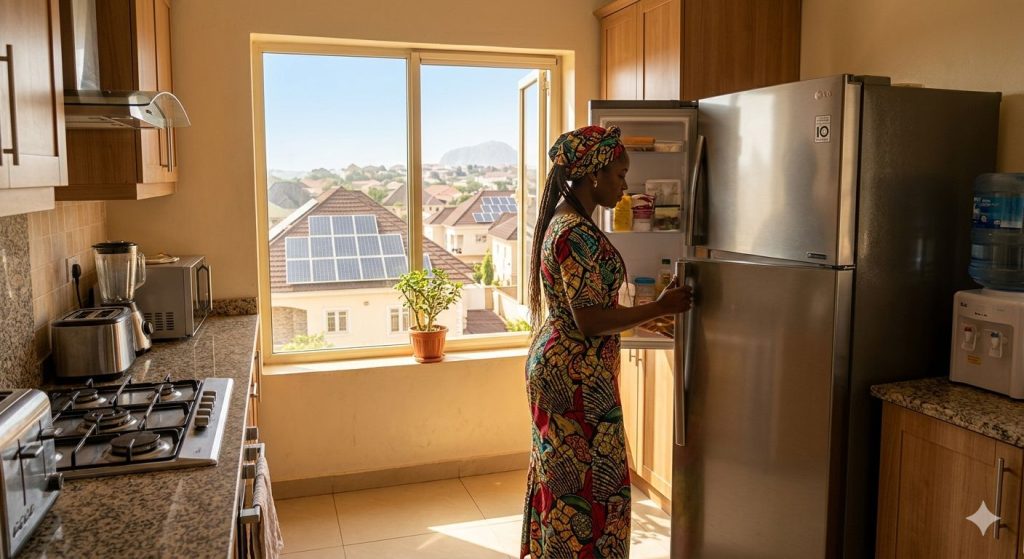
Smart Appliance Usage: How to Make Your System Last Longer
This is practical knowledge that most people learn the hard way. Once you’re on solar, how you use your appliances determines whether your batteries last 8 hours or 36 hours.
Refrigerators and Freezers These are deceptive energy consumers. A fridge doesn’t draw constant power — it cycles on and off — but it draws a significant surge each time the compressor kicks in. The smartest approach:
- Between 10am and 4pm: This is peak solar production. Your panels are generating maximum power. This is the best time to run your fridge and freezer — they’re drawing power directly from solar with minimal battery drain.
- Evening and night: If AEDC is available, let the fridge run on grid. If you’re fully off-grid, turn the fridge off in the evening if your battery charge is below 50%. A well-insulated fridge that’s already cold will maintain temperature for several hours.
- Morning before sun peaks: If the battery is low, turn the fridge off until the panels have had time to build charge back up. Turning it on at 7am when your batteries are at 30% and there’s still low sun will drain you quickly.
Air Conditioners Even a 1HP split AC draws 800W–1000W continuously. On a 2.5KVA system, that’s nearly half your capacity consumed by one appliance. If you must run AC on solar, do it between 11am and 3pm when solar production is at its highest. Never run AC overnight on batteries alone unless you have a large 48V lithium system sized for it.
Electric Kettles, Irons, Water Heaters, Washing Machines These are pure heating elements that draw enormous amounts of power (1,000W–3,000W). Keep these off your solar/battery system entirely unless you have a large commercial setup. Run them on AEDC or generator only.
LED Lighting Always, always switch to LED if you haven’t already. A room lit with 4 LED bulbs uses 40–50W. The same brightness with older bulbs could be 200W+. This single change extends your battery runtime significantly with zero other changes.
How a Hybrid Inverter Actually Manages Your Power
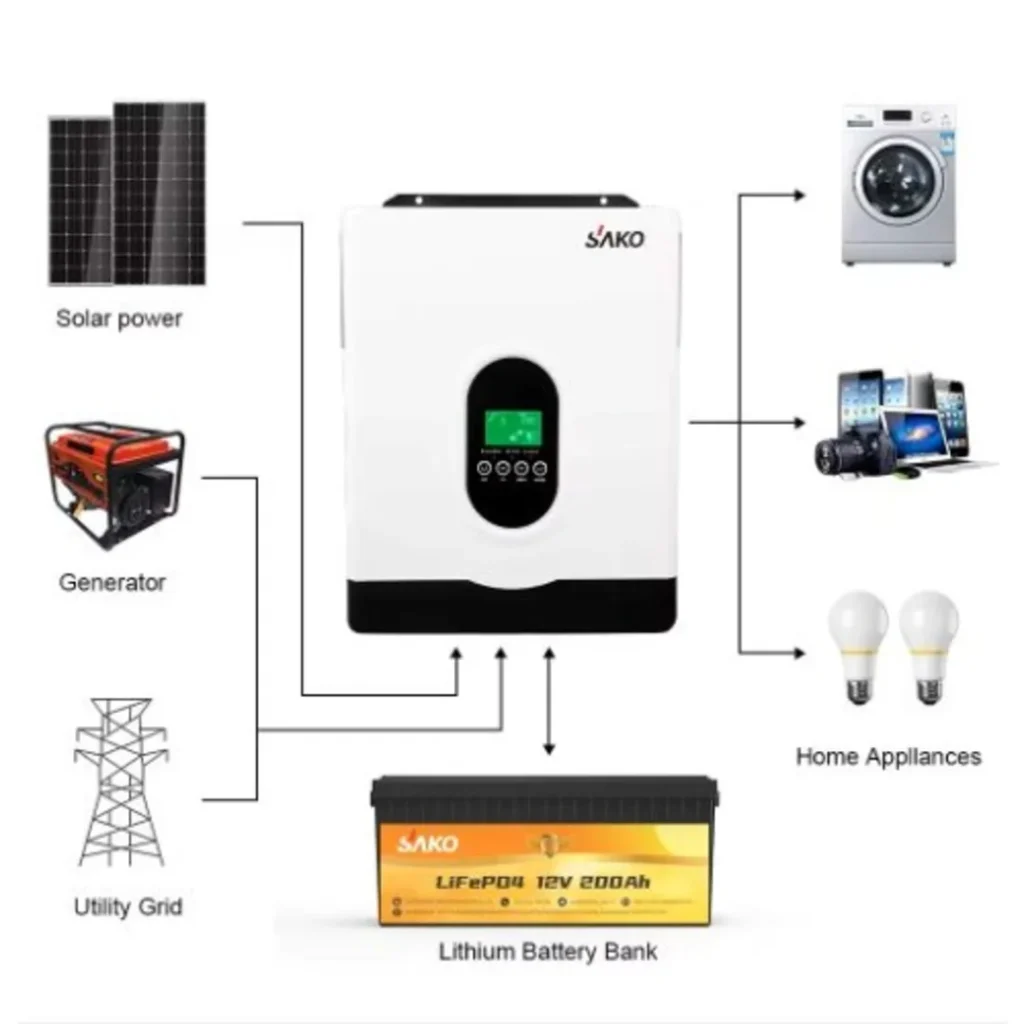
Understanding this helps you get the most from your system. A quality hybrid inverter follows a priority logic something like this:
- When AEDC is available: The inverter pushes your home load to the grid, simultaneously using solar to top up the battery and/or offset grid consumption. Your battery stays full for when the grid goes.
- When AEDC goes down but sun is strong: The inverter switches to solar. If your panels can carry the load, everything runs on solar and any excess charges the battery. If the load exceeds panel output, the battery fills the gap.
- At night or low-sun periods without AEDC: The battery powers your home. The inverter manages discharge to protect battery health.
- When battery reaches low threshold: The inverter either shuts non-essential loads or signals an alert, depending on configuration.
This intelligent load management is why hybrid inverters are worth the extra cost over a basic inverter-battery setup.
Battery Maintenance: What Nobody Tells You
If you’re using tubular (flooded lead-acid) batteries, this section could save you hundreds of thousands of Naira.
Topping up battery water: Every 3 months, check the electrolyte level in each battery cell. Top up with distilled water only — not tap water, not bottled drinking water. Tap water contains minerals that contaminate the electrolyte and accelerate battery degradation. Distilled water is available at most Solar companies and shops in Abuja.
Keep terminals clean: Battery terminals corrode over time. Clean them with a wire brush and apply petroleum jelly or terminal grease to prevent corrosion.
Check for swelling or damage: A swollen battery is a dangerous battery. If your batteries are bulging, replace them immediately.
Battery replacement timeline: Plan to replace or recondition tubular batteries every 2–3 years under regular use. This isn’t a failure — it’s just their nature. Factor this into your long-term cost calculations when comparing tubular vs lithium.
Never fully discharge: Discharging a tubular battery below 50% of its capacity repeatedly will significantly shorten its life. Your inverter should have a low-voltage cutoff — make sure it’s set correctly.
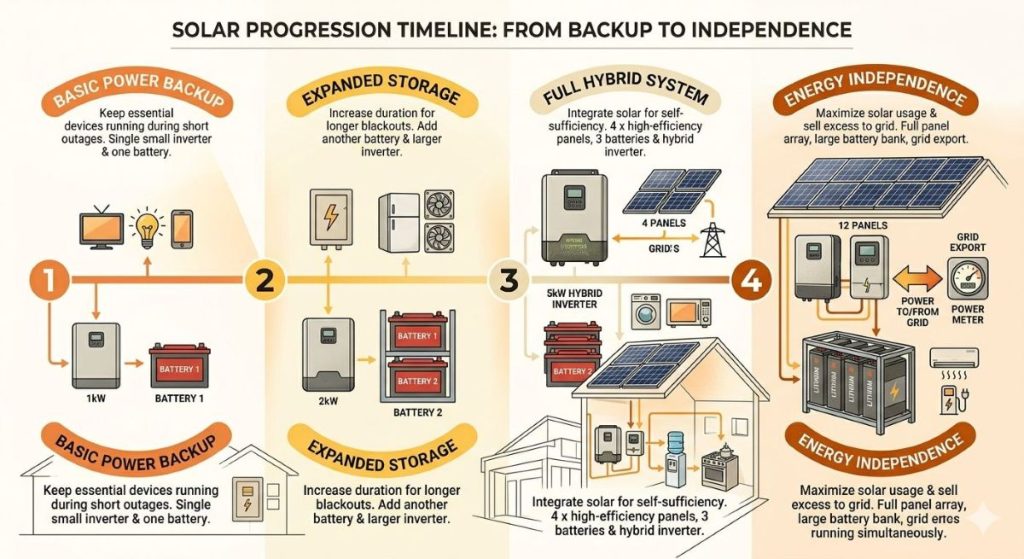
My Personal Solar Journey: From One Battery to Where I Am Now
I want to share this because I think it’s more useful than a spec sheet. This is my actual progression, what worked, what didn’t, and where I’m going next.
Stage 1 — The Beginning 1KVA Su-Kam inverter + 1 × 220Ah tubular battery (12V system). No solar panels.
This was entirely grid-dependent. When AEDC went down, I had stored battery power — enough for lights and a fan for maybe 24 hours under careful usage. When it ran out, I went back to darkness. The inverter was doing its job but I was at AEDC’s mercy completely. Still, it was a revelation compared to nothing.
Stage 2 — Adding Solar Panels Same 1KVA Su-Kam inverter + 1 × 220Ah battery + 2 × 180W panels (12V system)
Adding two 180W panels changed everything in terms of mindset. I could now generate some power during the day even when AEDC was absent. Under heavy usage the battery would start dipping from around 7pm, but with moderate discipline it could stretch to 30 hours. The lesson here: panels give you independence during daylight, but evenings still require careful management at this scale.
Stage 3 — Scaling Up 1.2KVA Haustrom inverter + 2 × 220Ah batteries + 2 × 180W panels + 1 × 350W panel (12V system)
The second battery made a meaningful difference in run time. Adding the 350W panel increased daytime generation noticeably. At this stage, under moderate usage, the system could run for about 48 hours without AEDC — a significant milestone. The Haustrom inverter handled the load more cleanly than the Su-Kam, and the extra battery meant I wasn’t stressing about an appliance running overnight.
Stage 4 — Current Setup 2.5KVA De-Bull hybrid inverter + 2 × 220Ah batteries + 2 × 180W panels + 1 × 350W panel (24V system)
Upgrading to the De-Bull hybrid and moving to a 24V system was a game changer in terms of inverter intelligence. The hybrid management works well. However — and this is the honest part — I’m getting about 36 hours from the batteries currently, which is slightly less than Stage 3 in absolute hours. Why? Because I’m now on a 24V system but running the same total panel wattage (710W). The 24V system is more efficient but it also has a higher appetite. My panels aren’t generating quite enough to fully satisfy the system during the day, so the batteries work harder to compensate overnight.
This is the exact reason I’m upgrading the panels.
Stage 5 — Incoming Plan Same 2.5KVA De-Bull hybrid inverter + 2 × 220Ah batteries + 3 × 600W panels (24V system)
Replacing my current panel array with three 600W mono panels (1,800W total) is the next move. Tripling the solar input while keeping the same inverter and batteries should dramatically reduce battery strain during the day and push more power into storage. I’m optimistic this will push the run time well beyond 48 hours under moderate usage and give the hybrid inverter enough solar to genuinely offset AEDC dependence rather than just supplement it.
The upgrade also positions me well to add a third battery later without needing to change the inverter.
FAQs — Solar & Inverter Setup in Abuja
What is the cheapest solar setup I can buy in Abuja? You can start from around ₦350,000–₦500,000 for a basic inverter and one tubular battery without panels. This gives you stored power from AEDC but no solar independence. Add two 280W panels and a charge controller for another ₦150,000–₦250,000 and you have a functional starter solar system.
What is the difference between a 2KVA and a 5KVA inverter? The KVA rating tells you how much load the inverter can handle at once. A 2KVA inverter can power roughly 2,000 watts of appliances simultaneously — enough for lights, fans, a fridge, and a TV. A 5KVA inverter can handle 5,000 watts — enough to add air conditioning and larger appliances. Choose based on your actual load calculation, not guesswork.
Can I run an air conditioner on solar in Abuja? Yes, but you need a properly sized system. A 1HP split AC draws 800–1000W continuously. To run it on solar comfortably, you need at least a 5KVA hybrid inverter on a 48V system with 6+ high-wattage panels and sufficient battery storage. Attempting to run AC on a 2.5KVA system will overload the inverter or drain batteries in hours.
How long do inverter batteries last in Nigeria? Tubular batteries under regular use last approximately 2–4 years before needing replacement or reconditioning. Lithium (LiFePO4) batteries last 8–15 years. Lifespan depends heavily on usage patterns, maintenance (water top-ups for tubular), and whether you avoid deep discharges.
Is a hybrid inverter worth the extra cost? Almost always yes, if you have solar panels. A hybrid inverter manages your grid, solar, and battery sources intelligently, extending battery life and maximising solar use. The cost difference over a basic inverter pays for itself quickly in fuel savings and reduced AEDC bills.
How many solar panels do I need for a 3-bedroom house in Abuja? A typical 3-bedroom house with moderate usage (lights, fans, fridge, TV, laptops — no heavy ACs) needs roughly 4–8 panels in the 400W–600W range, paired with a 3.5KVA–5KVA inverter and adequate battery storage. Get a proper load calculation done before purchasing.
Where can I check current solar prices in Abuja? Jiji.ng is the most accessible marketplace for checking current Abuja solar prices from multiple sellers. Compare several listings and always verify with the seller before committing.
What is the best inverter brand for home use in Abuja? Brands commonly found and used in Abuja include De-Bull, Growatt, Deye, Felicity, Su-Kam, Haustrom, and Luminous, among others. Brand preference varies, but for hybrid systems in the 2.5KVA–5KVA range, Growatt and Deye have strong market presence and parts availability. Always confirm local availability of spare parts and support before buying any brand.
Conclusion
Solar in Abuja is no longer a question of if — it’s a question of how much and when. The national grid is not improving fast enough to justify waiting, and the long-term economics of solar have never been more compelling.
The honest truth is that you don’t need to start with a ₦5 million system. I started with one inverter and one battery. The key is to start with a plan — know what tier you’re at, know what you’re working toward, and build each component in a direction that allows upgrades rather than replacements.
If you’re starting from zero, begin with a 24V system even if your first setup is modest. It will save you from having to re-wire everything when you inevitably want to expand. Buy quality batteries from the start — cheap batteries that fail in 8 months cost more than decent batteries that last 3 years. And get your wiring done properly by a professional the first time. The breakers, earthing, and cable sizing are what stand between your investment and a fire hazard.
For help finding trusted solar professionals in Abuja who can execute any of these setups properly, visit our Top Solar Installers in Abuja guide.