7 Best EV Charging Stations in Abuja: Locations, Costs and What You Should Know
Electric vehicles are gradually becoming more visible on Nigerian roads, and Abuja is emerging as one of the country’s important locations for electric mobility. As more Nigerians consider switching from petrol-powered cars to electric vehicles, access to reliable charging infrastructure is becoming an increasingly important consideration.
Fortunately, finding an electric vehicle charging station in Abuja is becoming easier, with charging facilities and emerging charging hubs across areas such as Wuse 2, Jabi, the Central Business District and Garki.
From fast-charging stations and solar-powered charging facilities to electric vehicle experience centres, Abuja now has several options for EV owners who need to recharge their vehicles.
However, questions remain about where to charge an electric car, how much public charging costs, whether charging stations are free and whether every electric vehicle can use any available charger.


This guide explores some of the known EV charging stations in Abuja, their locations, charging options and what you should know before visiting.
Table of Contents
Where Can You Find EV Charging Stations in Abuja?
Electric vehicle charging facilities in Abuja are concentrated around commercial districts, shopping destinations, vehicle dealerships and specialised mobility centres.
Some of the locations identified in our research include:
- Wuse 2, particularly around Hombori Crescent and the Art Tech District.
- Jabi, around Jabi Lake Mall and Bala Sokoto Way.
- Central Business District, including Unity Road.
- Garki, particularly Area 11.
- Mbora District, around the A.Y.M Shafa Energy filling station.
- Airport Road, around Bill Clinton Drive.
These facilities offer different charging arrangements, including DC fast charging, destination charging and solar-powered charging.
Below are some of the charging locations worth knowing about.
1. Bartum Electric – Yellow Door EV Charging Station, Wuse 2
Location: 19 Thaba Tseka Street, Wuse 2, Abuja.
Bartum Electric’s Yellow Door EV Charging Station is one of the charging facilities identified in Wuse 2.
The facility reportedly features two dual 60kW DC fast chargers with GB/T DC connectors. It also has generator backup, on-site parking and card payment facilities.
The station is listed as operating 24 hours daily, making it a potentially convenient option for EV owners who need charging access outside regular business hours.
Its GB/T connector specification is particularly important. Drivers should confirm that their vehicles support the connector before visiting.
2. CAAS Charging – Wuse 2
Location: No. 7 Hombori Crescent, Wuse 2, Abuja.
CAAS Charging is one of the prominent names associated with public EV charging infrastructure in Abuja.
Its Wuse 2 facility is associated with the development of dedicated public fast-charging infrastructure in Nigeria. The installation has been described as featuring four DC superchargers with capacities of up to 350kW.
This makes it an important development in Abuja’s emerging electric mobility network.
The facility has also been associated with Possible Electric Mobility, which is involved in developing charging infrastructure and supporting electric vehicle adoption.
Drivers should confirm the current operating status, available charging capacity and applicable tariffs before making a trip.
For updates, visit CAAS Charging on Instagram.
3. Jemag Solar EV Hub – Jabi Lake Mall
Location: Jabi Lake Mall, Bala Sokoto Way, Jabi, Abuja.
Jabi is another important destination for electric vehicle charging in Abuja.
The Jemag Solar EV Hub at Jabi Lake Mall provides a destination-charging option for EV owners visiting the shopping centre.
The facility is described as a solar-powered DC fast-charging hub. Its charging infrastructure also forms part of a broader electric mobility service offering that includes EV diagnostics and repairs.
One interesting aspect of the installation is its use of locally assembled smart lithium battery technology to support charging operations.
The location is particularly convenient for drivers who want to combine shopping or other activities with vehicle charging.
The reported operating hours are Monday to Saturday, 8:00 am to 9:30 pm, and Sunday, 12:00 pm to 9:30 pm.
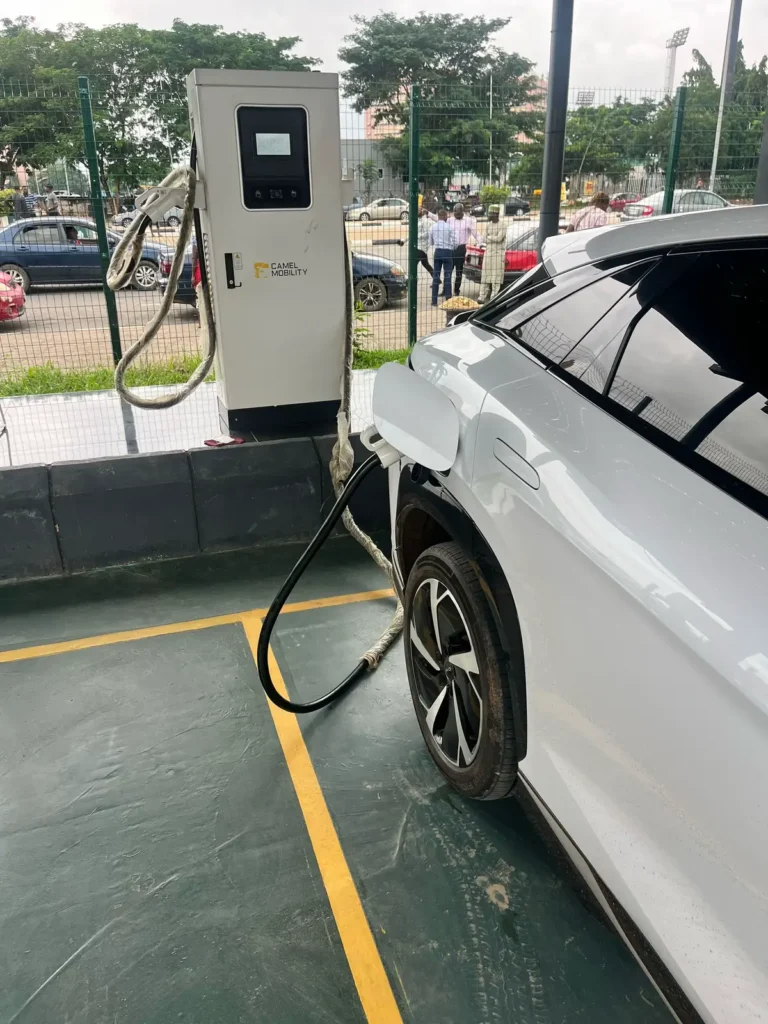
4. BANKROL CAMEL EV – Central Business District
Location: Plot 740, Unity Road, Central Business District, Abuja.
BANKROL CAMEL EV is another notable electric vehicle charging destination in Abuja.
The facility advertises a solar-powered charging system designed to provide charging access around the clock.
Its charging infrastructure has been promoted with a combined capacity of 400kW and individual supercharger guns capable of delivering up to 120kW.
The station also incorporates battery energy storage to support its solar-powered operations.
This is particularly relevant in Nigeria, where unreliable grid electricity can create challenges for public EV charging infrastructure.
BANKROL CAMEL EV advertises 24-hour access and promotional charging benefits for customers. These include one free charging session after registration and 12 free sessions for customers purchasing an EV from the company, subject to its terms.
Contact: 090-2045-7777
Operating hours: Advertised as 24 hours daily.
For EV owners in Abuja, the facility offers another option for accessing fast charging in the city centre.
5. EV Charger Abuja – Jabi
Location: Zone B04, 1265A Bala Sokoto Way, Jabi, Abuja.
EV Charger Abuja is associated with public electric vehicle charging and EV charger installation services.
The Jabi location provides an option for drivers looking for charging facilities around Bala Sokoto Way.
Beyond public charging, the business also offers services relating to residential and commercial EV charger installation.
This is useful for EV owners who want to install charging equipment at their homes, offices or business premises instead of depending entirely on public charging stations.
For installation, maintenance and related services, visit EV Charger Abuja.
6. KB Lamah Motors EV Charging Station – Garki
Location: 16 Onitsha Crescent, off Gimbiyya Street, Area 11, Garki, Abuja.
KB Lamah Motors is another business offering electric vehicle charging services in Abuja.
Located in Area 11, Garki, the facility promotes EV charging as part of its wider electric mobility offering.
The station advertises 24-hour access and fast-charging services.
It also highlights the benefits of electric mobility, including reduced running costs, quieter operation and zero tailpipe emissions.
For drivers living or working around Garki and neighbouring districts, the location provides another charging option outside the Wuse 2 and Jabi corridors.
Contact: 08032970035
Operating hours: Advertised as 24 hours daily.
7. Electric Vehicle Experience Centre – Art Tech District, Wuse 2
Location: Art Tech District, Wuse 2, Abuja.
The Electric Vehicle Experience Centre in Wuse 2 offers something slightly different from a conventional charging station.
Rather than focusing exclusively on charging, the centre also provides an opportunity for members of the public to learn about electric vehicles, understand how they work and experience electric mobility firsthand.
Visitors can explore electric vehicles and reportedly have opportunities to test-drive them.
Another notable feature is the availability of free EV charging for electric vehicle owners using the facility, although visitors should confirm the current terms and availability before visiting.
The centre is particularly useful for people who are curious about electric vehicles but have not yet experienced driving one.



Other EV Charging Locations to Know in Abuja
In addition to the locations above, there are other emerging and institutional charging installations worth knowing about.
A.Y.M Shafa Energy Filling Station, Mbora District
The Mbora charging hub is associated with a partnership involving NNPC New Energies Limited, Shafa Energy and Nigus International.
The installation is described as a solar-powered EV charging facility integrated into a traditional filling station.
Its off-grid solar energy arrangement is intended to reduce dependence on the national electricity grid.
Energy Commission of Nigeria Headquarters, Central Business District
The Energy Commission of Nigeria has been associated with a solar-hybrid EV charging installation at its headquarters in Abuja.
The facility also has an institutional and research purpose, demonstrating the potential integration of renewable energy into electric transportation.
Bill Clinton Drive, Airport Road
An additional charging location has been advertised on Bill Clinton Drive, Airport Road, beside an NNPC filling station.
The location provides another potential charging option for motorists travelling around the airport corridor.
EV owners should confirm the precise entrance, operating arrangements and charging availability before making a dedicated trip.
How Much Does It Cost to Charge an Electric Car in Abuja?
One of the biggest questions prospective EV owners ask is how much it costs to recharge an electric vehicle in Nigeria.
The answer depends on where you charge, the electricity tariff, the charging provider and the capacity of your vehicle’s battery.
Generally, charging at home can be cheaper than using commercial public charging stations, particularly when you have access to a favourable electricity tariff or a properly sized solar installation.
Estimated public EV charging costs
Based on the indicative commercial tariff figures in our research, public charging costs can be estimated as follows:
| Charging type | Estimated price per kWh | Cost for a 40kWh battery |
|---|---|---|
| Public AC charging | ₦300 | ₦12,000 |
| Public DC fast charging | ₦500 | ₦20,000 |
These are indicative figures, not confirmed tariffs for every charging station in Abuja. Individual operators may charge different rates.
Actual charging costs may also differ because of charging losses, battery condition and the amount of energy required.
How much does home EV charging cost?
Home charging can offer significant savings, particularly for people who already have a reliable electricity supply or solar power system.
For illustration, consider an electric vehicle that consumes approximately 18kWh of electricity to travel 100 kilometres.
Using an electricity rate of ₦209.50 per kWh:
18kWh × ₦209.50 = ₦3,771.
This means travelling 100 kilometres could cost approximately ₦3,770 in electricity before charging losses.
The actual amount will depend on the vehicle, driving conditions and electricity tariff.
Electric cars vs petrol cars: Which is cheaper?
To understand the potential savings, consider the following illustrative comparison using the supplied May 2026 petrol price benchmark and electricity tariff:
| Vehicle type | Consumption per 100km | Estimated cost |
|---|---|---|
| Petrol car | 10 litres at ₦1,596.25/litre | ₦15,963 |
| Electric car | 18kWh at ₦209.50/kWh | ₦3,771 |
Under these assumptions, an electric vehicle could save approximately ₦12,192 for every 100 kilometres travelled, before charging losses.
This is one of the major financial arguments for electric mobility in Nigeria.
However, the calculation does not include the initial purchase price of the vehicle, charger installation, battery replacement considerations or other ownership expenses.
What Are the Different Types of EV Charging Stations?
Not all electric vehicle chargers work in the same way. Understanding the different charging levels can help you choose the right facility.
1. AC Standard Charging (Level 2)
AC charging is commonly used for homes, hotels, offices and other locations where vehicles can remain parked for extended periods.
These chargers typically deliver between 7kW and 22kW.
The electricity passes through the vehicle’s onboard charger, which converts it into the direct current required by the battery.
Depending on the vehicle’s battery capacity and onboard charging capability, a full charge may take approximately six to eight hours.
2. DC Fast Charging (Level 3)
DC fast charging is designed for situations where drivers need to recharge their vehicles more quickly.
Unlike AC charging, the conversion from alternating current to direct current takes place within the external charging equipment.
This allows electricity to be supplied directly to the vehicle’s battery at higher power levels.
DC fast chargers can deliver between 50kW and 350kW or more, depending on the equipment and vehicle compatibility.
A typical compatible EV may charge from 10% to 80% in approximately 20 to 30 minutes at a sufficiently powerful station, although actual charging times vary.
For commercial fleets, long-distance journeys and drivers who cannot wait several hours, DC fast charging is particularly useful.
Can You Use Any Electric Vehicle Charging Station?
No. Not every electric vehicle can use every charging station.
Compatibility depends on the connector type, charging standard, vehicle specifications and the power supported by the vehicle.
For example, some charging facilities use GB/T connectors, while other electric vehicles may use CCS, Type 2 or other charging standards.
Before visiting an EV charging station in Abuja, check:
- The connector supported by your electric vehicle.
- Whether the station provides AC or DC charging.
- The maximum charging power supported by your vehicle.
- Whether the station requires an application, QR code or another payment method.
- Whether the charging facility is currently operational.
This is particularly important when using high-powered DC fast chargers.
A 350kW charging station does not necessarily mean your vehicle will charge at 350kW. The vehicle’s battery and charging system determine the maximum power it can accept.
Are EV Charging Stations in Abuja Free?
Some EV charging facilities may offer free charging, but most commercial charging services are expected to charge customers for the electricity supplied.
The Electric Vehicle Experience Centre in Wuse 2 has been reported to offer free charging to EV owners.
BANKROL CAMEL EV has also advertised promotional benefits, including one free charging session after registration and additional free sessions for customers who purchase an electric vehicle from the company.
However, free charging should not be assumed at every station.
Before visiting, contact the operator or check its latest announcements to confirm whether free charging is available and whether any conditions apply.
How Do You Pay for Electric Vehicle Charging in Abuja?
Payment arrangements depend on the charging station and its operator.
Some public charging facilities support digital payment methods, which may include:
- QR-code payments.
- Bank transfers.
- Debit card payments.
- Mobile payment wallets.
For example, the commercial charging information supplied for Abuja indicates that customers may scan a QR code displayed on the charger and complete payment electronically.
Other facilities may have their own payment procedures.
It is advisable to confirm the accepted payment methods before connecting your vehicle.
Is Solar-Powered EV Charging Available in Abuja?
Yes. Solar-powered electric vehicle charging is gradually becoming part of Abuja’s developing charging infrastructure.
This is particularly important in Nigeria because electricity supply can be inconsistent.
Some charging facilities are incorporating solar panels and battery energy storage systems to reduce their dependence on grid electricity.
BANKROL CAMEL EV is one example of a facility advertising a solar-powered charging arrangement.
The Jemag Solar EV Hub at Jabi Lake Mall and the solar-powered installation associated with the A.Y.M Shafa Energy filling station in Mbora are other examples.
Solar-powered charging can improve energy resilience and provide an alternative to relying entirely on the national grid.
For private EV owners, installing an appropriately sized solar and inverter system can also make home charging more economical over time.
Can You Install an EV Charging Station at Home in Abuja?
Yes. Electric vehicle owners can install charging equipment at their homes, offices or commercial premises.
Home charging offers convenience because you do not need to visit a public charging station every time your battery needs replenishing.
However, the installation must be designed around the vehicle’s charging requirements and the available electrical infrastructure.
Important considerations include:
- The vehicle’s connector and charging standard.
- The required charger capacity.
- Available electricity supply.
- Electrical wiring and protection equipment.
- Generator or solar backup requirements.
- Installation location and safety.
If you need assistance with EV charger installation, repairs or maintenance in Abuja, you can explore EV Charger Abuja.
Before purchasing charging equipment, ensure that it is compatible with your vehicle and installed by a qualified professional.
Tips for Using EV Charging Stations in Abuja
If you own an electric vehicle or are planning to purchase one, these practical tips can make charging easier.
1. Confirm availability before travelling. Not every listed charging station will necessarily be operational at all times. Contact the operator before making a special trip.
2. Check connector compatibility. Confirm that the charging station supports your vehicle’s charging standard.
3. Understand charging costs. Ask whether the operator charges per kWh, per session or through another pricing arrangement.
4. Keep alternative charging locations. Identify more than one charging facility around your regular routes, especially if you frequently travel between Wuse, Jabi, Garki and the Central Business District.
5. Understand your vehicle’s charging limits. A high-powered charger does not guarantee that your vehicle will accept electricity at the charger’s maximum rated capacity.
6. Consider home charging. If you have a suitable electrical installation, home charging can reduce your dependence on public charging facilities.
The Future of Electric Vehicle Charging in Abuja
Abuja’s electric mobility infrastructure is still developing, but the emergence of private charging operators, solar-powered charging hubs and EV experience centres indicates growing interest in the sector.
The expansion of charging infrastructure will be important to the wider adoption of electric vehicles in Nigeria.
More strategically located charging stations could make it easier for private vehicle owners, commercial transport operators and fleet businesses to adopt electric mobility.
There is also an opportunity to integrate charging infrastructure with renewable energy, particularly solar power and battery storage.
As electric vehicle adoption increases, the availability of reliable charging facilities, standardised connectors, transparent tariffs and convenient payment systems will become increasingly important.
For now, EV owners in Abuja have several charging locations to explore, particularly around Wuse 2, Jabi, Garki and the Central Business District.
Frequently Asked Questions About EV Charging Stations in Abuja
1. Where can I charge my electric car in Abuja?
Some identified EV charging locations include CAAS Charging in Wuse 2, Bartum Electric in Wuse 2, Jemag Solar EV Hub at Jabi Lake Mall, BANKROL CAMEL EV in the Central Business District and KB Lamah Motors in Area 11, Garki.
2. Are there Tesla charging stations in Abuja?
Our supplied research does not establish a dedicated Tesla Supercharger network in Abuja. Tesla owners should confirm connector compatibility and charging access with individual operators before visiting.
3. How much does it cost to charge an electric car in Nigeria?
Costs depend on the charging provider and electricity tariff. The indicative figures in this guide are ₦300 per kWh for public AC charging and ₦500 per kWh for public DC fast charging. Actual operator tariffs may differ.
4. How long does it take to charge an electric vehicle?
AC charging may take several hours, depending on battery capacity and charger power. DC fast charging can be considerably quicker, with some compatible vehicles reaching 80% charge in approximately 20 to 30 minutes under suitable conditions.
5. Are electric vehicle charging stations open 24 hours in Abuja?
Some facilities, including Bartum Electric and locations advertising services from BANKROL CAMEL EV, list 24-hour access. However, confirm current availability before visiting.
6. Can I charge my electric vehicle at home?
Yes. You can install a compatible EV charger at home, provided your electrical installation can safely support the equipment.
7. Is EV charging cheaper than buying petrol?
Generally, charging an electric vehicle can cost considerably less per kilometre than purchasing petrol, particularly when using affordable home electricity or solar power. Actual savings depend on electricity tariffs, petrol prices and vehicle efficiency.
8. Do all EV charging stations support every electric car?
No. Charging compatibility depends on the vehicle’s connector, charging standard and supported charging power. Always check these details before using a public charger.
9. Where can I install an EV charger in Abuja?
EV Charger Abuja provides EV charger installation, repair and maintenance services. Visit https://evchargerabuja.com.ng/ for more information.
Conclusion
Electric vehicle charging infrastructure in Abuja is gradually expanding, giving EV owners more options for charging their vehicles around the city.
From fast-charging facilities in Wuse 2 and the Central Business District to solar-powered charging hubs in Jabi and Mbora, the capital is beginning to develop the infrastructure needed to support electric mobility.
Although challenges relating to electricity supply, charging compatibility and public charging costs remain, the growing number of charging initiatives is an encouraging development.
If you already own an electric vehicle or are considering making the switch, knowing where to charge and what to expect can make ownership considerably easier.
As Abuja continues to embrace new transportation technologies, electric vehicle charging stations will likely become an increasingly important part of the city’s transport and energy landscape.
For more information about transportation and mobility in the capital, explore our guide to Abuja Air Shuttle and its electric buses.